Saturday, 9 April 2011

Lesotho and Swaziland

Swaziland - What would it be like? What did I know of the place? Well, I knew it was a land locked country granted independence by Britain in 1968, it's one of the last remaining absolute monarchies in the world and has a horrific HIV/AIDS problem. The HIV infection rate in Swaziland is the highest in the world at about 26% of all adults,and over 50% of adults in their 20s. This has stopped possible economic and social progress, and is at a point where it endangers the existence of its society as a whole. Swaziland could become the first country in the world to actually collapse because of this an AIDS epidemic. Swaziland's HIV epidemic has reduced life expectancy to only 32 years as of 2009, which is the lowest in the world by six years. What else. Oh yeah, Richard E. Grant grew up here!

I went online to improve my Swazi-knowledge. I should have known better. I read this online! Swaziland also has one of the highest numbers of people struck by lightning per capita in the whole world and it is common to know (or know of) somebody who has been struck by lightning. Oh that's just great.


Swazi police - look British


I crossed my shadow today. Since I started this trip in Alaska last July I have never been anywhere where I've been before (that's the whole point of this trip after all) but today I crossed my shadow. Two years ago I led a sixth form school trip to South Africa/Mozambique and the road I went up today was the same one we came down then. I only mention this as I didn't have an altogether positive experience of South Africa on that trip. But now I'm having a much better time. Must be something to do with being alone on a motorbike rather than in a coach with twenty six 16-18 year old boys from my school and twenty four 16-18 year old girls from another school - and a driver who didn't know where he was going - and a back window smashed in my drunks near the border... Ah those were the days....


So Swaziland - First things first. The border. All in all it took less than 30 minutes to leave South Africa and enter Swaziland. No photocopies of anything needed, South Africa even refused to cancel my carnet (I didn't even show it to the Swaziland side). I assume it's because I'm going back in but it wasn't very clear so we shall see what happens. It was all so quick, hassle free and easy (£5 road tax was all I paid to enter) Those 3- 4 hour Central America crossings seem a long time ago now.

Swaziland is a small country, nothing is more than 150 km away so I wasn't in a rush and chose to stop at a small game reserve that Tom had told me about. Because there are no dangerous animals bikes are allowed in, there's a camp site and you can walk around. I turned up early afternoon, paid my £7 camp site fee and road through the reserve. Tom had told me that they had seen giraffes on the way down to the camp site and as I turned one corner....


Giraffe pretending to be a tree


Amazing. Obviously the noise of the bike scared them a little and just for a few moments I was riding along on my bike next to two galloping giraffes. It was quite magical. Giraffes are so big that when they run it almost looks like slow motion and riding along next to them even for a few moments was new motorbiking experience for me and something I shall never forget. I'm truly in Africa now.


I was the only person camping and had the whole reserve to myself that night. I went for a two hour walk (not going too close to the river as there are crocodiles apparently,) and although I didn't see any more zebra or giraffe I did see lots of impala and numerous colourful birds (including several toucans). When I got back to the camp site I had been joined.... by some vervet monkeys and a family of warthogs. What a great day. Incidentally, I saw the local paper today. There was a notice of someone who had died. Instead of saying “Dom Giles has passed away” It said “Going Home notice. We announce that Dom Giles is going home...” I like that.

Camping alone in Swaziland

Motorbike safari!


Next stop the Ezulwini Valley. Swaziland's capital (Mbabane) has no attractions at all but nearby is the Ezulwini Valley – Swaziland's royal heartland and tourist centre. Lush green hills, wooded game parks, the National parliament, football stadium and museum. Not to mention a brand new shopping mall and casino. This eclectic mix seems to sum up the country quite well. I stopped off at the national museum (I was the only visitor) and scrubbed up on my Swazi history and culture. Go on ask me something I bet I know?


In the museum I stumbled across this..

The beginning of abstract thinking?


Its a stone spear point dating back 75 – 80,000 years. The description says “ Many Archaeologists argue that these spear point demonstrate the earliest form of abstract thinking anywhere in the world. The points are so fine and beautifully made they could never be for hunting. They were made to be beautiful and this has symbolic value and meaning. But to have symbolism we must have language and abstract thinking. Therefore these points demonstrate abstract thinking.” Quite a find then for a small rarely visited museum.


I then headed for the Sondzela Backpackers Lodge which was going to be home for the night. It offered me a space to camp (for £5), wonderful views, a resident warthog family and the chance to walk through the Mlilwane wildlife sanctuary in which it was situated. I went for a walk and saw deer, zebra and warthogs. Swaziland will, for me, always be the land of motorbike and walking safaris. Something I didn't think I'd be able to do at all on this trip to Africa.


There's only four of us staying at Sondzela's. A South Koran who's been on the road for 22 months and has visited 80 countries. And an Italian/S. African couple who live in London. They told me that last night there was an enormous storm. Thunder and lightening and torrential rain. The South Korea guy, who is camping, moved indoors. Today he's put his tent away. As we spoke it started lightening outside. No rain or thunder just flashes of light across the sky. Very spooky. They certainly get interesting weather in these parts.


I've been looking around. As I've been travelling through Swaziland I've been looking at all the people. I don't think I've seen a single person who looks older than me. Maybe it's just because I know life expectancy is only 32 but it does seem that the population is very young.


The road out of Swaziland had some great views - apparently


Ah History. What would do without it eh? What's a holiday without a tour of a battlefield or a trip to a massacre site or a traipse around a war cemetery? There hasn't been enough history on thdomwayround and I'd decided to put this right. So on my way from Swaziland to Lesotho I was going to stop off at Dundee and visit some battlefields.

The Boer War or more correctly the Anglo-Boer wars. It all began in 1881 when the Boers beat the British and declared the South African Republic. (The Boers by the way are Afrikaan speaking descendent of the Dutch settlers. Boer means farmer in Dutch).

The British didn't think this was cricket and decided on a replay. War broke out in 1899 and by 1902 Britain had won. The British distinguished themselves by inventing concentration camps and over 26,000 Boer men women and children died of disease and starvation. I believe just over 7000 British and 7000 Boer soldiers actually died in the fighting.

Between these two Boer wars however the British had also been annoying the Zulus, or more importantly the Zulus had been annoying the British. Zululand is (very roughly) that part of South Africa between Swaziland and Lesotho. In 1879 the British Army fought the Zulus (who were presumably not supposed to be armed with anything more viscous than some Guava halves*). For more details watch the 1964 film Zulu staring Michael Caine. In the Battle of Rorke's Drift 139 British soldiers successfully defended a small mission station from around 4000 Zulu warriors. The much less commercially successful, Zulu Dawn (1979) recalls the Battle of Isandlwana where the British were annihilated by 25,000 Zulus.
Isandlwana - can you see the white cairns in the distance?


I detoured off the main road into Dundee to visit the site of the Isandlwana battle. The British (mainly the 2nd Warwickshire) were camped by the hill and ambushed (if you can be ambushed my 25,000 Zulu warriors!). As a battlefield site it was, in my experience, fairly unique and quite moving. Large white cairns had been placed on the spot where the British had died. It made a striking and evocative point and I was quite moved by it. I feel a little embarrassed to have joked about Guava halves now(which was a quote from Blackadder by the way)


I found these cairns quite moving


At the battle of Isandlwana, 1357 British soldiers died, around 1000 Zulus also perished. The Zulu Nation won the Battle but not the war and within 10 years the British Empire had annexed Zululand. Swaziland took heed of this and negotiated a peace with Britain which, I think, is the main reason Swaziland remained a country.


At the Isandlwana museum I found a list of all the British who had died in the battle. (We Brits. may not be good a winning things but we are bloody good at keeping score). Tracy will tell you I do this a lot and I don't really know why but I just had to look down the list to see if there were any Giles'. I know that Giles is only my fathers fathers fathers surname and over one hundred years ago I must have had eight surnames if you see what I mean. But I looked down the list and found one: Sergeant Edward Giles of the Ist Battalion, 24th Regiment of the 2nd Warwickshires.


I've always wondered why Lesotho wasn't part of South Africa, Now I know. In the late 19th Century the Boers and the Basotho (people of Lesotho) squabbled a lot and the King of Lesotho (Mosheshoe) asked Britain for protection. Strictly speaking he should first have asked the British administration at Cape Colony but he bypassed them for the imperial government in London. The British viewed continual war between the Orange Free state (Boers) and Basotholand (Losotho) as bad for their own interests and annexed the nation. One unexpected benefit of this was that, when the Union of South Africa was created in 1910, Basotholand was a British Protectorate and was not included; had Cape Colony retained control, Lesotho would have become part of South Africa. So, now you know too.

Heading to Lesotho I read this in the Lonely Planet. Several lives are lost each year from lightening strikes; keep off high ground during an electrical storm and avoid camping in the open.

How can you keep off high ground. The lowest point in the county I still above 1000 metres.

Approaching Lesotho I passed through some South African roadworks. The tar was wet and the bike got covered...


Would I find a jet wash in Lesotho?

The 100 miles from the border to the capital was lovely rolling hills, rural settlements but it was getting cloudy and dark up above. I won't bother going over old ground again. Needless to say it started raining as I got close to Maseru (capital of Lesotho) and then the lightening. I dived into the first car wash I could find.

These guys were over the moon to have the chance to wash a motorbike and boiled up a fresh pot of hot water and worked at scrubbing the tar off for around an hour, whilst the thunderstorm moved on.


I printed out the previous photo and gave it to the boss.


I spent two nights in Maseru, not especially because it required it. I don' think I've ever been to a capital city that has less to offer. The Lonely Planet has no suggested sites to see, the main centre comprising of one street which, as far as I could tell was home to shops celling mobile phones. Maseru's industry seems to be built on the notion that South Africans need a conference centre and the few hotels there were were set up as such (I stopped at one which was asking for £110 a night – I moved on)


The reason I had a whole day in Maseru was to catch up with an ex student. I had taught Lerato when I working in Ethiopia and through the power of facebook, email and mobile phones I'd just managed to get in touch with her the day before I arrived. It was wonderful to catch up with someone after 8 years of no news whatsoever. Lerato was born with spina bifida and has had more trials and tributations to deal with in her life than I can imagine. And yet she is a positive, enthusiastic and strong woman and a true inspiration.


I was in Maseru on the day Spurs played Real Madrid in the quarter final of the Champions League. I managed to find a room in the backpackers I was staying in that had a TV.

The result was Real Madrid 4 Spurs 0
Attendance: 3. Me a bucket and a mop


and I'm sure the mop and bucket were supporting Real.


I left Lesotho under a cloud

Graaff-Reinet. No not a disease but the next town on my way back to Cape Town. Set in the Great Karoo, a vast wilderness area of South Africa Graaff-Reinet is a throw back to Dutch/Boer days and the architecture is very colonial. All the white people in town talk Afrikaans and the town's main church is a Dutch Reform church. The only other interesting thing about the place was that I found it quite hard to find somewhere to stay. There were 6000 Methodist Nuns in town and all the cheap hostels had been booked up! Thinking my chances of pulling that night were lower than usual I turned in for an early night.


In the morning I caught up with two motorbikes on the lonely road through the Karoo. Neil and Di are from the UK but have a house in South Africa and had hired bikes for a week. It was great to ride along for the day with other bikers – I realised that although I'd met a couple of bikers I hadn't actually ridden with anyone since Tracy and I entered Honduras with Chris and Alan in December.


Getting closer to Cape Town I stopped at Oudtshoorn, the Ostrich capital of the world. I arrived on a Friday afternoon just in time to coincide with some sort of street festival. I later found out it was the 16th annual Afrikaans festival. Celebrating all things Afrikaans. Now I must admit at first that filled me with some dread. I expected a sort of neo-Nazi parade of the AWB and a town full of fat men with long white beards. Actually I was quite shocked at how racist I was being. I walked thorough town and sure enough there were lots of white people about and they were ALL speaking in Afrikaans but I had no reason to believe they were any more or less racist than anyone else. I guess my opinion of Afrikaans has been solely formed by living through the 1980s. Every time white South Africans appeared on TV it was something to do with apartheid. (I'm also in the middle of reading Nelson Mandela's Autobiography.)


But the real reason I'd come to Oudtshoorn was for this...


The Swarzberg pass. 24 km long and up to 1600 m. Not as hard as the Sani pass and perhaps not quite as spectacular but still an excellent saturday morning ride out.

Right, that's it for this week. It's taken over 2 hours to load this, and as I move towards Namibia I assume wi-fi will become less and less common and I'll be able to load a blog but with fewer pictures.


Friday, 1 April 2011

Ups and Downs - emotionally and geographically

I must admit to being a bit emotional when I left Cape Town on Saturday morning. I was, obviously, very excited and thrilled to be on the road but I was also a little scared I guess. But why? This wasn't anything new, I had just ridden from Alaska to Panama. But as I rode along I realised that it was FOUR whole months since I'd actually really been on my own. FOUR months since I'd ridden without Tracy on the back and now I was on my own again. That's why I was a little apprehensive and, to be honest, lonely.

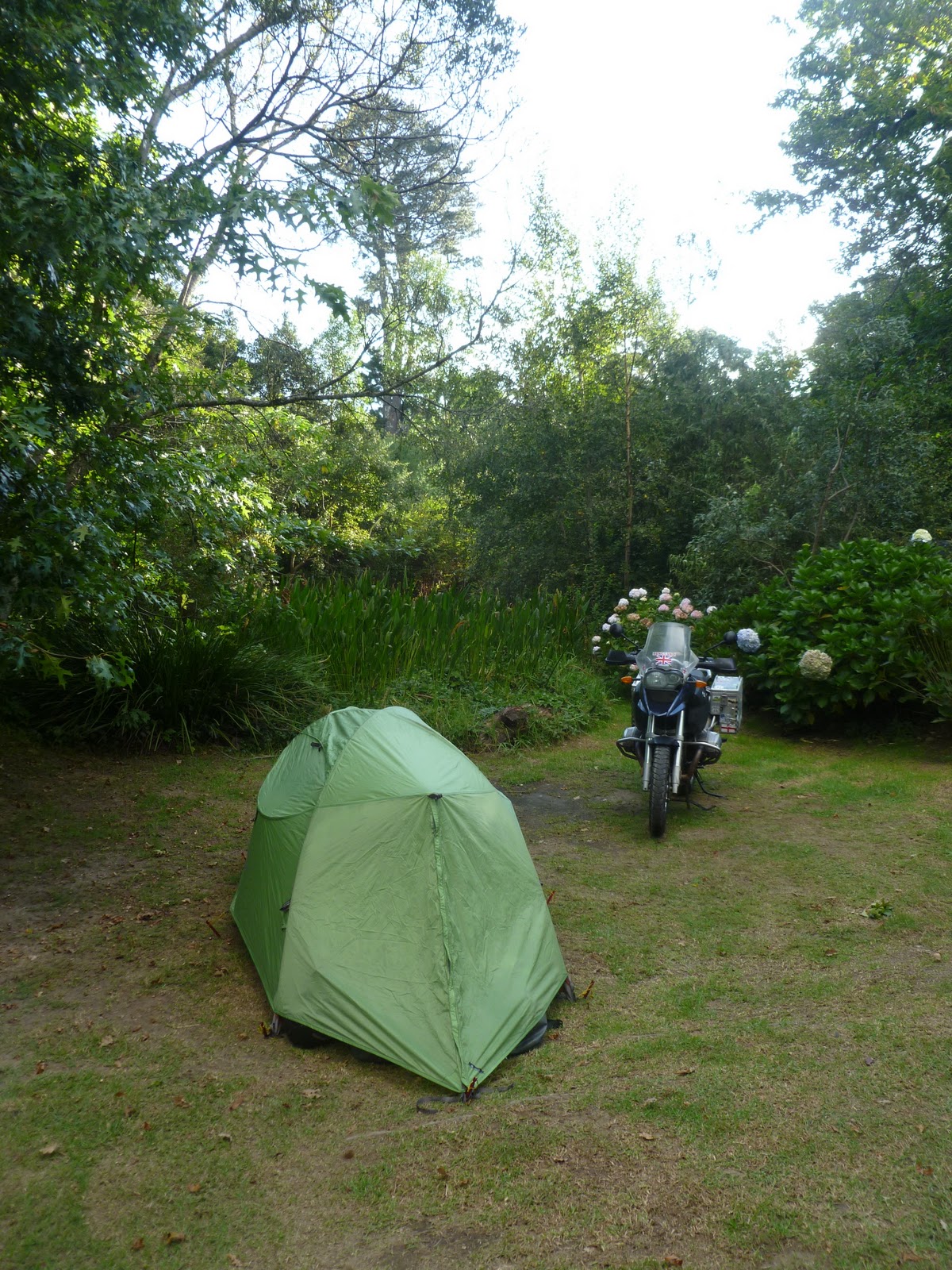
Knowing that made me feel better and I enjoyed the easy ride along N2 towards Mossel Bay. I got there in the early afternoon, found the caravan park by the sea and pitched my tent. Again, as I put up my new tent for the first time (I'd donated my old, leaky tent to the Turtle people in Baja as I wasn't going to carry a tent through Central America) I realised that it had been 5 months since I'd actually camped. The last time was just north on Los Angeles in October. Although this Africa section is really just a continuation of thedomwayround it feels like I'm starting a whole new adventure. I got that feeling I'd had when I'd left for Alaska. That feeling of, “What am I doing? Whatever made me think I could do this? This is stupid I should pack up and go home.” My first night under canvass in Africa was a slightly depressing and unhappy one.

My first camp in Africa. (Nice long African shadows)
The following day, feeling better (Mornings are always great. That anticipation of the day ahead, anything could happen and nothing has gone wrong yet, kind of feeling) I rode “The Garden Route”. Now admittedly I didn't stop at any of the surfing beaches or take any side trips so I may have missed the best parts of the Garden Route but I have to say it was just a little disappointing. It is a lovely part of the country, very green and rural with lots and lots of sandy beaches and some great surfing I'm told. And it was a great day but maybe it had been oversold. It seems that after Kruger National Park and Cape Town the garden route is THE thing to do when in South Africa, and perhaps I was expecting too much.

At the end of a long day (400 miles) I stopped in Hogsback north of East London. Renowned as the place a very young JRR Tolkein came when he lived in Bloemfontein the Lonely Planet waxed lyrical about the place. A veritable Hobbiton. I camped at a place called “Away with the faeries” and some people there certainly seemed to be. Whilst I was setting up camp a guy came to say hello and said, “Ah, you're thedomwayround, I've been following your blog.” Always good to meet the readers!

Ah, a nice quiet campsite with the Hobbits

Then a Nomad truck turns up - seemingly on a drinking tour.

Glen is a South African rider who lies nearby and was just up for the weekend. We had a good long chat in the bar and he told me I must do the Sani Pass. The famous snakelike pass that goes from South Africa into Lesotho. He talked me into it and in the morning I headed of for the Sani Lodge to see what all the fuss was about.


That's Lesotho up ahead

Now I know I went on about lightening when I was in Nevada and Utah and I may come across as a big girls blouse but it really does frighten me. 100 miles out of Hogback I rode into one almighty thunderstorm. Initially I didn't feel as scared as I'd been in the US as there were other people around and building and things but I seemed to be riding straight into it. I crested one hill and the wind picked up and the rain was almost horizontal. And them it happened. About 3-400 meters in front of me, right over the road, a god almighty bolt of electricity slammed into the ground. Within a millisecond I heard and felt the thunder. It was so loud I honestly felt my sternum shake. I kid you not. I stopped the bike as quickly and safely as I could without falling off. I turned the engine off, kicked the side stand down and jumped off. I was shaking. I walked away from the bike, about 30 meters, and just sat down in the wet grass at the side of the road. And I waited, and waited. The next bolt hit over to my right and the noise came a few seconds later. The thunder lasted for six seconds – I counted! I just sat there getting soaked – my waterproofs were nice and dry packed as they were in my panniers! A few minutes later another bolt, again further away struck and I began to feel a little better but I wasn't going to move, not yet. And then the wind and rain picked up again and I saw another flash. I couldn't tell, through the clouds, where it was coming from but after about five seconds I heard the noise, this time behind me. This was a new one. What should I do? I decided I'd had enough of lying in the grass, getting rained on and I'd try my luck on the road again. I got back on the bike and rode off. To cut a long story short the road seemed to run parallel to the storm for a good 20 minutes before I made it to a town and I stopped at a petrol station.

I know this all seems funny now. Obviously I didn't get killed and you probably aren't as afraid of lightening as I am. I'm just telling it as it is. In fact as I was typing this, sat in the Sani Lodge lounge, I felt a little silly about it all. Then I went outside and saw something I don't think I've ever seen before. Lightening but no thunder or rain – a true electrical storm. It was quite cloudy as well so the whole sky lit up with flashes of bright light, then total darkness. It was really quite aerie. I went back inside and asked if this was common. It was!

It started raining just as I went to bed and I sat in my tent for about 10 minutes as it rained and flashed and then started to thunder. I couldn't stand it. There was no way I was going to get to sleep in a tent in a lightening storm. I got up, grabbed my sleeping bag and headed back to the lounge. Everyone else had gone to bed by now and I just about to move into one of the empty dorms for the night when I heard a huge crash on the tin roof. Then another and another. It was hailing. But these were no ordinary hail stones.

Golf ball sized hail
I had a restless night, worried about the Sani pass, worried about lightening and worried that my poor bike was outside in the hailstorm.

Beautiful sunshine the next morning. And Heidi was fine. There are two other sets of campers sharing the campground with me. The English woman had also ducked into a dorm. For the night but the Australian couple had staying in their tent. Needless to say what's a bit of hail and lightening when you're used to camping with crocs. and black widow spiders and all sorts of snakes waiting to kill you.

I'm still apprehensive about going up the pass though. Actually it's the coming down that I'm worried about. I was hoping there'd be another biker or two here but it looks like I'm all alone again. I'm going to set off in a minute but am fully prepared to turn around when it gets too difficult. Or when it looks like it's going rain. There is no way I want to be stuck on a 2800 m high twisting mountain pass in a lightening storm. I wonder what the next paragraph is going to say?

I set off in glorious sunshine fortified by a breakfast consisting of Jersey milk. Those Jersey cows get everywhere. The 8 miles or so to the South African border post were relatively straight forward. I exited the RSA (no need to cancel my carnet as I would be back in a few hours) and prepared myself for the 5 miles ahead. That's all it was 5 miles but in those 5 miles I would climb 1000 meters, from 1900 to 2850.
I'll let the photos tell the story... All I need to say was that going up was tough, exhilarating, hard work and great fun all rolled into one.


Sani Pass - zig zagging up ahead

Initially the going was OK

Then it got steeper with sharper bends


I can't say I didn't falter occasionally. I think I stalled twice on corners and came close to dropping her once or twice. But we made it.

The hardest bit. Tight and rocky. I stalled and slide but made it

View back down the pass

That's one twisty road

Just near the top I met a biker coming down. He took a photo of me (another crap one) and I got a picture of him going down.

Not good of me OR the view. Oh well


At the top I got my passport stamped (“How long will you be staying sir”, “Oh, about an hour”). And performed an old Jedi mind trick on the customs official who wanted to see my South African road tax (“These are not the papers you're looking for. Move on.”) I pulled up at the Sani Pub – Africa highest Pub. The local beer has the strap line – How high can you get! I sat on the verandah and had a beer and a cigarette (Well actually I had a hot chocolate and I don't smoke, but this is supposed to be a motorbiking blog)

Lesotho - not the most pleasant entrance
I was extremely pleased with myself for having mad it up without falling off, and the views were truly stunning but in the back of my mind I was concerned about the trip down and I in no way wanted to be caught in an afternoon storm so I hopped back on Heidi and headed down.

Africa's highest pub - How high can you get?

Like most things in life the fear is in the unknown (or something like that) and the trip down wasn't as bad as I'd expected. But then again I HAD been on a BMW off road course with Simon Pavey! I remembered what he'd told me. First turn off the ABS. Then stick it in first gear and let the engine do the work. Stand on the pegs, grip the tank between your knees and use the rear break. Focus on what is up ahead not what is right in front of you and never look at where you don't want to go or you will go there. And it worked. I only had one scary section where I slide a little sideways as I locked the back break up but I was down in no time (well just over a hour actually) and safely back at the Lodge (having left Lesotho and re-entered South Africa of course).

Going down is easy if people GET OUT OF THE WAY!

Can I count this as my Africa river crossing, please?


Now I'm not an emotional guy but I was well pleased what what I had done. If I'm going to ride safely though Southern Africa I'm going to have take on a challenge or two and it's great to know that I can. I really feel that I've pushed myself today and had great fun riding through this fabulous scenery. Well done me!

So, all in all I'd covered 30 miles, entered and left a country and gone up, then down, 1000 metres, all in four and a half hours. Quite some day.

So, now that I've ridden over 1000 miles up South Africa I'd better explain what it's like. Well, I have to say that I don't think I've ever been anywhere that reminds me so much of England. It's not just the language and the fact that they drive on the left, it's also the scenery. I think I once described Alaska as like Scotland on steroids. Well the South Africa that I've been riding through is a little like rural England on steroids. Rolling hills (with Jersey cows on them) towns and villages churches (some of them purposefully mocking English Norman churches) golf courses, crown green bowling and cricket pitches. Obviously there are one or two more banana plantations, Rooibos tea plantations and wineries here than in Warwickshire (I did say reminded me – not it's the same) but I can't help feeling it's similar. Over one hundred years ago my great grandmother emigrated to this part of South Africa, perhaps it wasn't as far from home for her as it looked on a map.


Mike


I made a friend,albeit temporarily. Leaving Sani I stopped at a petrol station and saw a BMW 1200GS with a UK number plate go by. I caught him up and we stopped for coffee and a chat (I suppose we should have had tea being British, oh well) Mike has been on the road, on and off, for years and was at the end of a UK-South Africa trip that saw him get through Egypt just in time. Although he'd seen and done a lot he was an unassuming guy and I milked him for all the information I could before parting ways. I'd told him I was thinking of going to Sodwana Bay to dive. He said I should check out the Aliwal Shoal just south of Durban. So I changed my plans and headed there. (Incidentally, this is something I wouldn't normally do. I'm quite rigid about sticking to a plan and the fact that I've just changed my plan over a cup of coffee with a guy I just met might seem like small potato to you but for me this is something new. The Sani Pass, this and later St. Lucia - Perhaps this trip is changing me?)

The night before the dive I went to the local bar, which was a bit of a dive in it's own right. I got chatting to a local called Henry who was very concerned about me travelling on my own (he was worried about me being lonely) and insisted on giving me his phone number should I need any help whatsoever. Not in any creepy weird way I might add. See - the world is full of nice people.

Aliwal Shoal – one of the top ten dive sites in the world. The shoal, 4 miles out to sea was created from dune rock about 30,000 years ago. ( Yes, that's right my Utah Mormon friends - that's thirty thousands years ago; get over it) 6,500 years ago the sea level rose creating the reef. It was a great days diving. Perhaps the best dives I've done in a while. I saw black tipped sharks, one manta ray (no one else saw it!), hawksbill turtle, Octopus, nudibranchs, electric blue spotted puffer fish, huge stone fish, and lots and lots of reef fish. Mind you my dive buddy and dive Instructor was more interested in looking for sharks teeth in the sand. And I felt really sick on the boat between dives and nearly threw up on the second dive. But it was still a great couple of dives. (Note to wife: Sorry Tracy, I'll bring you here one day and I want you back as my dive buddy!)


Moving on up the coast I stopped at St. Lucia Estuary. Again this was suggested to me by someone in an email and I took his advice. And what good advice it was. The small town of St. Lucia is completely surrounded by a Natural World Heritage Site and is the most ecologically diverse tourist destination in Southern Africa. (I “could” see – Elephant, Leopard, Rhino, Hippo, Buffalo, turtles nesting, crocs in the water and hippos walking down the street apparently. This area has the highest number of Black Rhino in one place on earth, 525 species of birds, 35 species of frog, 36 species of snake, 800 hippos and 2000 crocs.

Beware of crocs and hippos

If Tracy were here she'd say "Look at their little ears!"

I'm protected!


Rather bizarrely the tourist brochure has a timeline of the place and says this about 1928. Huberta, St. Lucia's most famous Hippo, left her pod and began an epic journey of 1600 km across South Africa. In 1931, after crossing 122 rivers, she was killed by hunters in the Keiskamma River. I have so many questions....

I arrived just after 6 p.m. Almost breaking my rule of not riding at night and couldn't find the backpackers with a campsite that was mentioned in the LP. I stopped at a motel/lodge type place the first time I've done this in South Africa and was very pleasantly surprised. Nice room, with a fan and real hot water for only £20. (Camping would probably have been about £7). Africa is going to be so much cheaper than North America :)

The reason I chose the motel I did was because I saw an adventure bike parked in the car park. When I got back to my room after taking a stroll around town (no Hippos about) I found a note on my bike. It read, “Alaska, we are in room 14. leaving early in a.m. Want to do breakfast? Tom – Washington, Pat and Christina, Quebec.” How could I refuse. I don't think I've ever DONE breakfast before.


What a surprise I got in the morning. Tom was the one and same Tom who'd I'd met briefly in Canada at the motorbike rally last August. He's offered me a bed for the night in Washington which I hadn't taken him up on. And Pat and Christina had also been at the rally. It was like meeting old friends. We had a very long breakfast and swaped stories and pieces of advice for over three hours. Eventually they left, heading south but I've got their number and am sure we'll meet up again. We're all heading the same way anyway.

Tom loading his V-Strom

Pat and Christina with their loaded Afric Twin

I spent a quite, pleasant and hot day in St. Lucia. I rode up to the estuary and saw some hippos and as soon as I post this blog I'll go out again for sunset and see what I can find. Heading into Swaziland tomorrow and aiming for a Game reserve that Tom told me about. It lets motorbikes in (unlike most) and they saw giraffe and warthogs on the short ride to the camp ground. Should be good.

This last week has been amazing. A few lows and many many highs. So far South Africa has surpassed all expectations and I most certainly am having the time of my life (apart from my wedding obviously. Oh and meeting Tracy in the first place and, it goes without saying, every day I've been with her.) But apart from that...